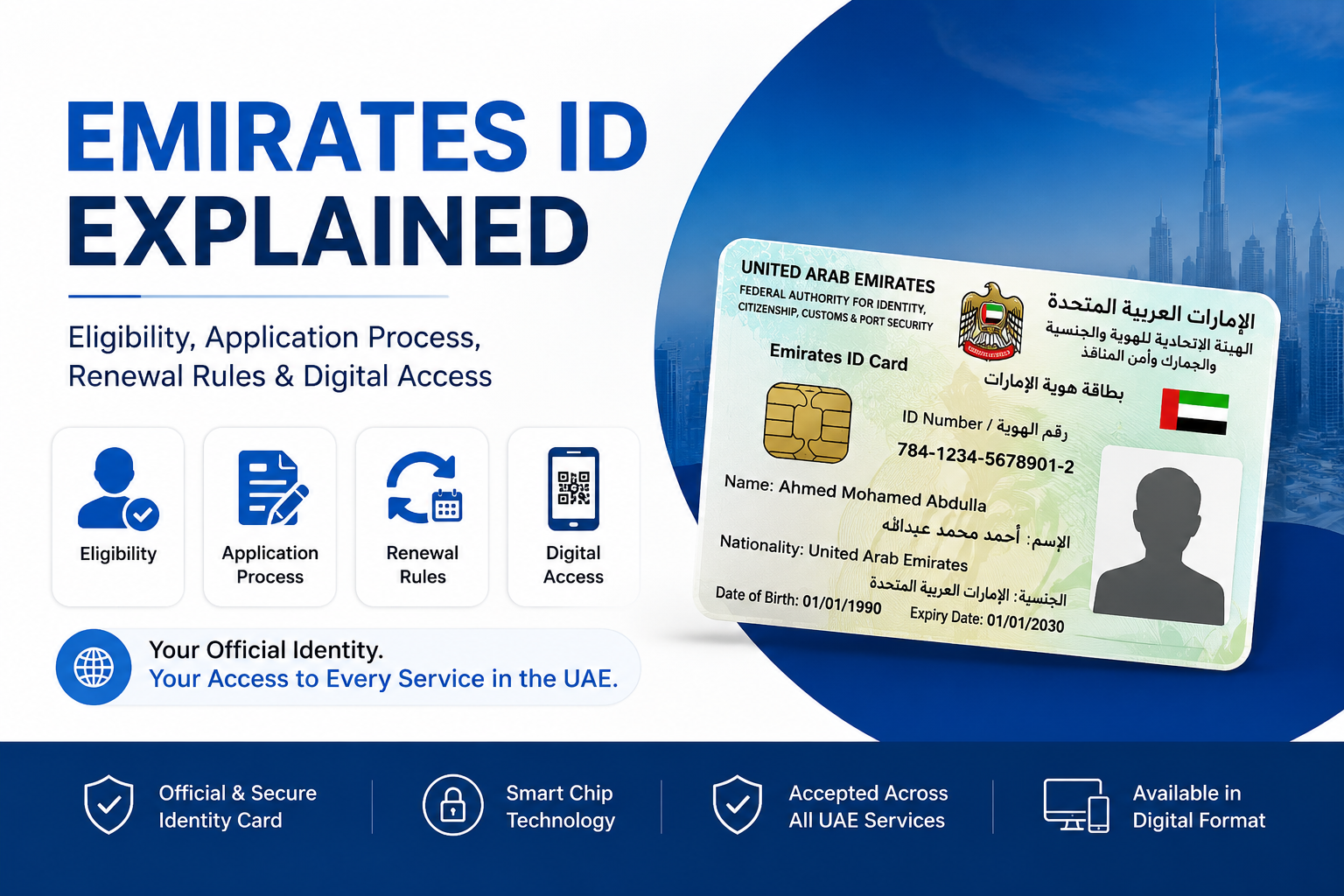
The Emirates ID is one of the most important identity documents in the United Arab Emirates (UAE). Whether you are a UAE citizen, GCC national, expatriate resident, or planning to move to Dubai, your Emirates ID serves as your official proof of identity throughout the country.
From opening a bank account and renting a home to accessing healthcare, obtaining a SIM card, and using government services, almost every major transaction in the UAE requires a valid Emirates ID.
Many people search online with questions like:
This complete 2026 guide answers all of these questions in simple language. Whether you're applying for your first UAE residence visa or renewing your existing ID, this guide explains everything step by step.
The UAE government continues to improve its digital identity system, making the Emirates ID more powerful than ever.
| Update | Details |
|---|---|
| Digital Identity | Emirates ID is fully integrated with UAE PASS. |
| Visa Sticker | Most UAE residents no longer receive a residence visa sticker inside their passport. |
| Smart Chip | Emirates ID now stores residency information electronically. |
| Government Services | More than 5,000 government and private services accept Emirates ID verification. |
| Travel | UAE citizens can travel to GCC countries using Emirates ID in eligible cases. |
| Digital Verification | Banks, telecom providers, hospitals, and government departments now verify identity digitally through Emirates ID. |
Today, the Emirates ID is much more than a plastic card—it's your digital identity in the UAE.
An Emirates ID is the official national identity card issued by the UAE government to every UAE citizen and legal resident.
It contains your personal information, biometric data, photograph, unique identification number, and residency details.
Unlike a passport, which identifies you internationally, the Emirates ID is used primarily within the UAE for identity verification and accessing public and private services.
Every resident must carry a valid Emirates ID while living in the UAE.
The Emirates ID is issued by the Federal Authority for Identity, Citizenship, Customs and Port Security (ICP).
Previously, this authority was known as the Emirates Identity Authority (EIDA).
Since government restructuring, ICP manages:
Every Emirates ID application is processed through ICP's official system.
The Emirates ID is mandatory for nearly everyone legally residing in the UAE.
It is issued to:
Every Emirati citizen receives an Emirates ID.
Citizens of GCC countries residing in the UAE also require an Emirates ID.
Foreign nationals with a valid residence visa receive an Emirates ID.
This includes people working in:
Even newborn babies are issued Emirates IDs after completing the required registration process.
Housemaids, drivers, nannies, gardeners, cooks, and domestic helpers also receive Emirates IDs after obtaining residency.
Without a valid Emirates ID, everyday life in the UAE becomes extremely difficult.
It acts as your universal identification document.
You need it for:
Most government departments now ask for your Emirates ID instead of your passport.
The Emirates ID offers much more than identity verification.
It is accepted throughout the UAE as your legal identification document.
Most government portals automatically verify your information using your Emirates ID number.
Hospitals and clinics use Emirates ID to retrieve your medical records.
Banks require Emirates ID to:
Employers use Emirates ID during hiring and payroll processing.
For eligible travelers, Emirates ID can simplify travel within GCC countries.
Using UAE PASS, residents can access hundreds of online government services without visiting service centers.
The Emirates ID is a smart biometric identity card approximately the same size as a standard bank card.
It is manufactured using durable polycarbonate material and contains multiple security features to prevent fraud and counterfeiting.
The card includes:
Every Emirates ID issued by ICP follows the same standardized layout.
The front side displays the cardholder's personal information.
| Field | Description |
|---|---|
| Full Name | Printed in Arabic and English |
| Nationality | Country of Citizenship |
| Date of Birth | Official birth date |
| Gender | Male or Female |
| Photograph | Official biometric photo |
| Emirates ID Number | Permanent 15-digit identification number |
| Expiry Date | Card validity |
| ICP Logo | Issuing authority |
The front side allows quick identification by government departments, banks, hospitals, employers, and immigration officers.
The reverse side contains technical and security information.
It includes:
The chip securely stores biometric information that can only be accessed by authorized systems.
One of the most searched questions online is:
"What do the numbers on my Emirates ID mean?"
Every Emirates ID contains a unique 15-digit permanent identification number.
Example:
784-2026-1234567-1
Let's understand each section.
| Section | Meaning |
|---|---|
| 784 | UAE Country Code |
| 2026 | Registration Year |
| 1234567 | Unique Individual Number |
| 1 | Verification Digit |
Unlike your residence visa, this number usually remains the same throughout your residency in the UAE.
Even if your card expires or is replaced, your Emirates ID number generally does not change.
Yes.
Your Emirates ID number is assigned only once.
Even if you:
your Emirates ID number generally remains unchanged.
Only the physical card gets replaced.
The UAE government uses advanced security technology to protect every Emirates ID.
Major security features include:
These features make the Emirates ID one of the world's most secure identity cards.
Many newcomers confuse the Emirates ID with a UAE residence visa.
Although they are connected, they serve different purposes.
| Emirates ID | UAE Residence Visa |
|---|---|
| Identity document | Legal residency permission |
| Used daily | Used for immigration purposes |
| Issued by ICP | Issued after visa approval |
| Required for services | Required to live and work legally |
| Physical smart card | Electronic residency record |
Once your residence visa is approved, you become eligible to receive your Emirates ID.
Many first-time residents misunderstand how the Emirates ID works.
Avoid these common mistakes:
| Feature | Information |
|---|---|
| Issuing Authority | ICP |
| Card Type | Smart Biometric Identity Card |
| Mandatory | Yes |
| Valid For | UAE Citizens & Residents |
| Contains Smart Chip | Yes |
| Digital Version Available | Yes |
| Linked with UAE PASS | Yes |
| Used Across UAE | Yes |
Applying for an Emirates ID is a mandatory step for every UAE citizen and legal resident. Whether you're moving to Dubai for work, joining your family, starting a business, or obtaining a residence visa, you'll need to complete the Emirates ID application process through the Federal Authority for Identity, Citizenship, Customs and Port Security (ICP).
In most cases, your Emirates ID application is submitted alongside your UAE residence visa application. Once your residency is approved, ICP issues your Emirates ID after biometric verification.
You can apply if you are:
The application process is straightforward and usually completed in a few stages.
Foreign nationals must first receive approval for a UAE residence visa before an Emirates ID can be issued.
Residence visa categories include:
Once your residence visa application is approved, the Emirates ID process begins.
Applications can be submitted through:
During the application, you'll provide:
After submitting the application, you'll pay the applicable government fee based on your visa validity.
You'll receive an application reference number.
Most first-time applicants aged 15 years and above must visit an ICP center for biometric registration.
Biometric collection includes:
Children below the required age may be exempt from fingerprint collection.
ICP verifies:
If everything is correct, the application moves to production.
After approval, your application status changes to:
"Card Printed Is Done."
This means your Emirates ID has been manufactured successfully.
Once printed, the card is handed over to Emirates Post.
You'll receive:
The card can either:
Required documents vary depending on your residency category.
You'll generally need:
Government fees depend on your residence visa validity.
| Validity | Government Fee |
|---|---|
| 1 Year | AED 100 |
| 2 Years | AED 200 |
| 3 Years | AED 300 |
| Replacement Card | AED 300 |
| Typing Center Charges | AED 30–70 |
Note: Service charges may vary depending on where you submit your application.
Golden Visa holders receive a long-term Emirates ID that matches the validity of their residence permit.
Benefits include:
Processing time depends on application type and document verification.
| Stage | Estimated Time |
|---|---|
| Application Submission | Same Day |
| Biometrics Appointment | 1–5 Days |
| ICP Verification | 1–3 Days |
| Card Printing | 1–2 Days |
| Delivery | 2–5 Working Days |
Typical Processing Time: 5–10 working days
Express government services may reduce processing time in eligible cases.
After submitting your application, you can track its progress online.
You'll need:
The online tracking system shows real-time updates from ICP.
The UAE government has transformed many public services into digital platforms, making it easier for residents to verify their identity without carrying physical documents. One of the biggest developments is the Digital Emirates ID, which is available through the UAE PASS application.
The digital version contains the same identity information as your physical Emirates ID and is accepted by many government departments, banks, telecom providers, hospitals, and service providers across the UAE.
While many organizations accept the digital version, there are still situations—such as certain banking procedures or international travel—where the physical Emirates ID may be required.
UAE PASS is the official digital identity platform of the United Arab Emirates.
It allows residents and citizens to:
Using UAE PASS saves time and reduces paperwork, making it one of the UAE's most important digital initiatives.
Getting your digital Emirates ID is simple.
Download the UAE PASS application from your device's app store.
Register using:
Complete facial verification.
Verify your account.
Your Digital Emirates ID will appear under your personal documents.
Every Emirates ID contains an encrypted electronic chip.
This chip securely stores important identity information.
The data includes:
Only authorized government systems can access this encrypted information.
Many newcomers believe both documents are the same.
However, they serve different purposes.
| Emirates ID | UAE Residence Visa |
|---|---|
| Identity Document | Immigration Permission |
| Used Daily | Used for Legal Residency |
| Smart Card | Electronic Visa Record |
| Required for Banking | Required for Living in UAE |
| Issued After Residency Approval | Allows Long-Term Stay |
Today, residency information is electronically linked to the Emirates ID.
No.
Your Emirates ID belongs to you.
Employers should not permanently keep your original Emirates ID unless legally required for temporary administrative purposes.
Always request its return after verification.
You should renew before your card expires.
Renewing early helps avoid:
Many residents begin the renewal process several weeks before expiry.
Yes. Every UAE citizen and legal resident must have a valid Emirates ID.
The Federal Authority for Identity, Citizenship, Customs and Port Security (ICP).
No.
The visa allows legal residency, while the Emirates ID serves as your official identity document.
Yes.
You can track your application using your application number or PRAN through ICP's online services.
Most applications are completed within 5–10 working days, although processing times may vary depending on the application type.
It means your Emirates ID has been successfully printed and is waiting to be dispatched.
Many organizations accept the digital version through UAE PASS, but some services may still require the physical card.
The Emirates ID is far more than a simple identification card—it is your gateway to life in the UAE. From proving your identity and accessing healthcare to opening bank accounts, renting property, and using government services, it plays a central role in everyday life for every resident.
Understanding how the application process works, knowing the required documents, tracking your application status, and using digital services like UAE PASS can save you time and help you avoid common mistakes.
Whether you're applying for your first Emirates ID, renewing an existing card, replacing a lost one, or simply trying to understand how it works, staying informed ensures a smoother experience throughout your residency in the UAE.
As UAE regulations and service procedures may change over time, it's always a good idea to verify the latest requirements before submitting your application.

Dubai is not building for today. Every crane on the horizon, every tunnel being...
Read More
Planning a trip to Dubai or anywhere else in the UAE? Whether you are visiting D...
Read More
Want to explore the side of Dubai beyond its glamorous skyscrapers and luxurious...
Read More
Planning to perform Umrah is a deeply spiritual and life-changing experience for...
Read More
Planning a Dubai trip begins with one important thing, which is booking the perf...
Read More