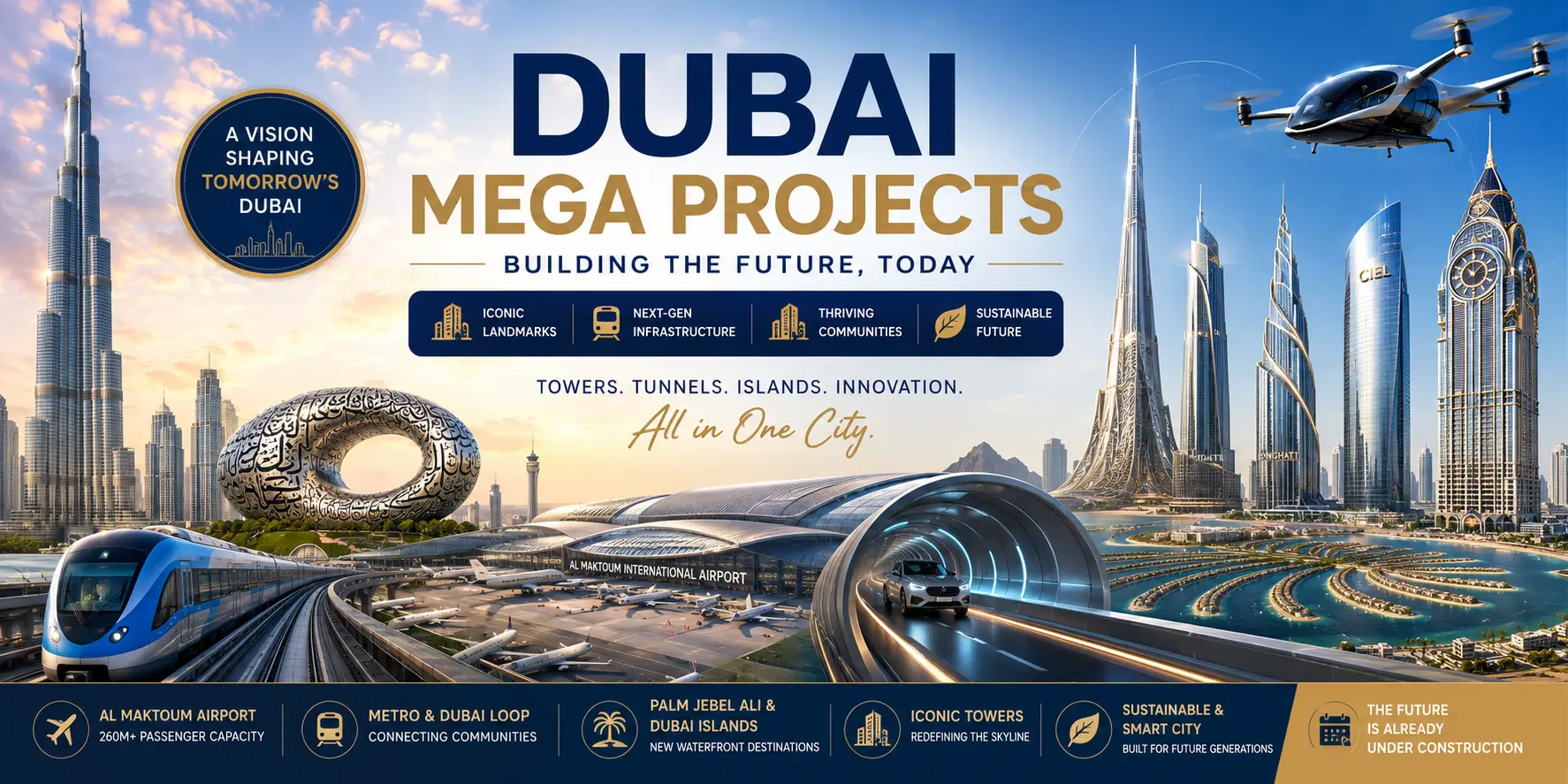
Dubai is not building for today. Every crane on the horizon, every tunnel being excavated underground, and every artificial island taking shape along the coastline reflects a city that is actively engineering its future. Whether you are planning a trip to Dubai or seriously considering investing in property, understanding the scale of these developments will completely change the way you see the city.
In 2026 alone, Dubai has more than AED 500+ billion worth of active construction across real estate, transportation, culture, and sustainability. These are not concept designs or future proposals. They are funded, government-backed, contractor-awarded Dubai mega projects that are transforming the city, one neighbourhood at a time.
This guide covers every major category—from the world's tallest towers and underground tunnel networks to off-plan villa communities and marine conservation cities in the Arabian Gulf. Each project includes the key details that serious planners need, including developers, locations, project value, and expected completion timelines.
Quick Summary
Dubai currently has more than 15 major mega projects under construction or in active tender. The combined investment value exceeds AED 1 trillion. These projects span iconic towers, airports, metro lines, artificial islands, solar parks, and floating museums, all aligned with the Dubai 2040 Urban Master Plan.
Most cities build reactively-roads come after congestion, and hospitals follow population growth. Dubai takes a different approach by planning decades ahead. The projects under construction today are not simply responses to current challenges. They are part of a long-term strategy to establish Dubai as a global hub for business, tourism, innovation, and sustainable living.
Several characteristics set these Dubai development projects apart:
In short, Dubai is not building skyscrapers for prestige alone. It is developing an aerotropolis—a city where the airport serves as the economic engine, surrounded by world-class residential, commercial, and leisure developments that justify billions of dirhams in investment every year.
For many people, Dubai mega projects are synonymous with record-breaking heights—and that perception is well deserved. Several of the world's most ambitious skyscrapers are currently under construction in Dubai. Below are the projects that have been officially confirmed, funded, and are moving forward.
Developer: Emaar Properties | Location: Dubai Creek Harbour | Architect: Santiago Calatrava
Dubai Creek Tower is the centerpiece of the entire Dubai Creek Harbour development. Designed by Swiss-Spanish architect Santiago Calatrava, the tower draws inspiration from the Arabian dhow sail, mosque minarets, and the lily flower. Once completed, it is expected to reach a height of between 928 and 1,400 metres, making it significantly taller than the Burj Khalifa.
Following a pause for design revisions, Emaar confirmed in January 2026 that the tender for the redesigned tower would be reissued during the first quarter of 2026. This officially marks the project's revival after years of speculation. The tower is planned to feature ten lily bud-shaped observation decks, sky gardens, the world's highest mosque, twenty floors of hotels and residences, along with a ground-level plaza that will include retail outlets, a museum, and an auditorium.
Once completed, Dubai Creek Tower is expected to redefine the city's skyline, much like the Burj Khalifa has over the past 15 years—but on an even larger scale.
| Detail | Information |
|---|---|
| Developer | Emaar Properties |
| Height | 928–1,400 metres (exact finalised design pending) |
| Location | Dubai Creek Harbour |
| Architect | Santiago Calatrava |
| Tender Status | Reissued – Q1 2026 |
| Key Features | 10 observation decks, world's highest mosque, sky gardens, hotels, residences |
Developer: Azizi Developments | Location: Sheikh Zayed Road | Completion: 2028
Standing at 725 metres with more than 131 storeys, Burj Azizi is currently under construction on Sheikh Zayed Road and is set to become the world's second tallest building upon completion. It is also the only freehold property on Sheikh Zayed Road, making it one of the most distinctive off-plan investment opportunities currently available in Dubai.
The tower will feature luxury residences, an all-suite seven-star hotel inspired by seven world cultures, a seven-floor vertical retail centre, the world's highest hotel lobby on Level 11, the world's highest nightclub on Level 126, and the world's highest observation deck on Level 130. The project is scheduled for completion in 2028.
Developer: DMCC / The First Group | Location: Dubai Marina | Height: 360 metres
Rising 360 metres above Dubai Marina, Ciel Tower is set to become the world's tallest hotel upon completion. The tower will feature more than 1,000 luxury suites, a helipad, and an observation deck, combining Japanese Wabi-Sabi design with Dubai's contemporary luxury aesthetic. As one of the most prominent new construction projects in Dubai Marina, it is expected to significantly reshape the district's skyline.
Developer: Binghatti Developers × Jacob & Co. | Location: Business Bay | Height: 550+ metres | Completion: ~2026
Burj Binghatti, rising more than 550 metres, is designed to become the world's tallest residential tower. Developed by Binghatti Developers in collaboration with luxury watchmaker Jacob & Co., the tower features a striking façade crowned with diamond-shaped spires inspired by baguette-cut diamonds.
The development will offer luxury two- and three-bedroom residences, including the Sapphire Collection and Emerald Collection, along with premium amenities such as an infinity pool, a spa, and a private concierge service. Positioned as a "hypertower," the project is designed for ultra-high-net-worth buyers seeking exclusive residences in Business Bay's expanding freehold property market.
Developer: DAMAC Properties × Franck Muller | Location: Dubai Marina | Height: 450 metres
Rising 450 metres above the Dubai Marina skyline, the Franck Muller Aeternitas Tower is set to become both the world's tallest branded residential tower and the world's tallest residential clock tower. The development is designed for premium buyers seeking an iconic address in Dubai Marina, with Swiss luxury branding seamlessly integrated into its architectural design.
The most transformative ongoing projects in Dubai are not the towers that dominate the skyline—they are the roads, rail networks, tunnels, and airports that keep a city of four million people moving efficiently. These large-scale infrastructure projects will shape how Dubai functions for decades to come.
Developer/Authority: Dubai Airports | Location: Dubai South / Jebel Ali | Target Capacity: 260 million passengers
Al Maktoum International Airport is arguably the most significant infrastructure project ever announced in Dubai. Phase one of the expansion is already underway, with a long-term plan to accommodate up to 260 million passengers annually, making it approximately five times larger than the current Dubai International Airport (DXB).
Once completed, the airport will feature more than 400 aircraft gates, five parallel runways, five passenger terminal buildings, and an underground rail system. The master plan also includes a dedicated aerotropolis known as Dubai South—a purpose-built community designed to accommodate more than one million residents.
The project is being delivered in phases, with full completion targeted for 2050. However, substantial operational capacity is expected well before the final phase is completed.
The Dubai Metro Red Line extension towards DWC is also planned. In addition, the Airport Express Line—a 55-kilometre metro corridor connecting DXB and DWC through five stations—is currently in the consultancy and design stage as of 2026.
Authority: Roads and Transport Authority (RTA) | Route Length: 30 kilometres | Stations: 14 | Opening: September 9, 2029
In May 2026, Sheikh Mohammed bin Rashid Al Maktoum inaugurated the main tunnelling works for the Dubai Metro Blue Line, a AED 20.5 billion transport project that will become the city's third metro line. The 30-kilometre route includes 14 stations, comprising seven elevated stations, four underground stations, and three interchange stations connected to the existing Red and Green Lines.
The Blue Line will connect Ras Al Khor Industrial Area, Al Warqaa, Mirdif, Dubai Creek Harbour, Dubai Silicon Oasis, Dubai Academic City, and Dubai International Airport. It is expected to reduce travel time by enabling direct journeys from DXB to major urban centres in approximately 20 minutes and is projected to serve around one million residents along its corridor by 2040.
Separately, the Dubai Metro Gold Line was approved in April 2026. The fully underground line will span 42 kilometres with 18 stations and is currently targeted to open in 2032.
| Metro Line | Length | Stations | Cost (AED) | Opening Year |
|---|---|---|---|---|
| Blue Line | 30 km | 14 | AED 20.5 billion (~USD 5.6 billion) | September 2029 |
| Gold Line | 42 km | 18 | TBC | 2032 |
| Airport Express Line | 55 km | 5 (proposed) | In design stage | TBC |
Developer: The Boring Company × RTA Dubai | Budget: AED 2.5 billion (~USD 680 million) | First Phase: DIFC & Dubai Mall
The Dubai Loop is one of the most talked-about ongoing projects in Dubai. Announced at the 2025 World Government Summit, the project will use Elon Musk's Boring Company tunnel technology to create an underground transit network connecting key districts across the city.
In its initial phase, the Dubai Loop will connect the Dubai International Financial Centre (DIFC) and Dubai Mall. The full network is planned to extend 22.2 kilometres with 19 stations, linking the Dubai World Trade Centre, Business Bay, and the wider financial district. The system is expected to accommodate up to 30,000 passengers per day, with the first phase scheduled to begin operations by mid-2026.
Partners: Joby Aviation, Archer Aviation, Skyports Infrastructure | Initial Launch: 2026 (Commercial Operations)
Dubai's Roads and Transport Authority signed an agreement with California-based Joby Aviation in February 2024 to introduce electric vertical take-off and landing (eVTOL) aircraft, commonly known as flying taxis, across the city. Sheikh Mohammed has already approved the vertiport designs, with four initial locations confirmed near Dubai International Airport, Palm Jumeirah, and key business districts.
Commercial operations are targeted to begin in 2026. Travel times across major city corridors are expected to range from 10 to 30 minutes, compared with 45 to 90 minutes by road during peak traffic. Dubai is positioning itself as one of the first cities in the world to operate a fully functional Advanced Air Mobility (AAM) network, making smart mobility a standard feature in all new master-planned communities.
Beyond the iconic towers and underground transport networks, the new developments in Dubai attracting the greatest investor interest are large-scale residential communities, particularly among buyers exploring the UAE's expat property market. Several of these major developments are currently available for off-plan investment.
Developer: Emaar Properties | Location: Dubai Creek Harbour | Area: 7.4 million sqm | Investment: AED 41+ billion
Dubai Square is being developed as a self-contained indoor city within the Dubai Creek Harbour district. Launched in late 2025, the project covers approximately 2.6 million square metres in its initial retail-focused phase and is planned to expand to a total area of 7.4 million square metres.
The development will include 10,000 homes, more than 1,500 hotel rooms, a wildlife sanctuary, a 7,500-square-metre retail district, AI-enabled navigation, and the world's first drive-through retail concept. The project is expected to open approximately three years after 2026.
Developer: Nakheel | Location: Jebel Ali Coastline | Status: Active Construction
Palm Jebel Ali is the largest of Dubai's palm-shaped artificial islands, significantly larger than Palm Jumeirah. Originally announced several years ago before being redesigned and revived, the project is now in the active construction phase. It will feature more than 80 hotels and resorts, thousands of freehold villa plots, beach clubs, marinas, and retail destinations. The island is positioned as Dubai's next premier waterfront address, targeting both luxury residential buyers and tourism developers.
Developer: Nakheel | Location: Deira Coastline | Status: Ongoing Phases
Dubai Islands, a collection of five islands off the Deira coastline, represent one of the region's most ambitious waterfront developments. The project will feature luxury hotels, beachfront residences, marina communities, and a large entertainment district. Several phases are already underway across the islands. For buyers seeking waterfront freehold properties, Dubai Islands remains one of the most actively marketed upcoming villa developments in Dubai.
Developer: Emaar Properties | Area: 60 Million Square Feet | Value: AED 41 Billion (~USD 11.2 Billion)
Set against Dubai's iconic skyline, this master-planned community will cover 60 million square feet and incorporate eco-friendly construction, wellness centres, spa facilities, and smart city infrastructure. It is one of the largest residential community announcements in Dubai's recent history, reflecting the growing trend toward large-scale, amenity-rich developments rather than standalone tower projects.
For those specifically interested in upcoming villa projects in Dubai, the following communities are currently in the active off-plan or early construction phase:
| Project Name | Developer | Location | Type | Estimated Handover |
|---|---|---|---|---|
| Palm Jebel Ali Villas | Nakheel | Jebel Ali | Beachfront villas, freehold | 2026–2028 |
| Dubai Islands Residences | Nakheel | Deira Coastline | Waterfront villas & apartments | 2027–2029 |
| Ghaf Woods | Majid Al Futtaim | Near Global Village | Forest-living villas, Dubai's first | 2027 |
| Dubai South Villas | Multiple Developers | Dubai South / DWC | Townhouses, villas, freehold | 2026–2028 |
| Grand Club Resort | Emaar | TBA | Mixed community | Multi-phase, post-2027 |
Disclaimer: All prices, handover dates, and project values mentioned in this article are based on publicly available information as of May 2026. These details are subject to change. Always verify the latest information directly with the developer or official sales channels before making any investment or purchase decision.
Not every major Dubai development project is a skyscraper. Some of the city's most significant new construction projects focus on sustainability, culture, and infrastructure. While these developments often receive less attention than the iconic towers, their long-term impact on Dubai's future is arguably even greater.
Authority: Dubai Electricity and Water Authority (DEWA) | Location: Seih Al Dahal, South of Dubai | Target: 5,000 MW by 2030
The Mohammed bin Rashid Al Maktoum Solar Park is the world's largest single-site solar energy project. It plays a central role in Dubai's Clean Energy Strategy 2050, which aims to generate 75% of the emirate's energy from clean sources by 2050.
As of 2026, multiple phases of the project are already operational, with the full 5,000 MW capacity scheduled for completion by 2030. Both its massive physical scale and its contribution to Dubai's net-zero ambitions make it one of the most important development projects in the city's history.
Developer: URB | Area: 200 Square Kilometres | Focus: Marine Research, Ecotourism & Reef Restoration
Dubai Reefs is one of the most unconventional new developments in Dubai—a floating sustainable city dedicated to marine research, reef regeneration, and ecotourism. The project aims to support more than 1 billion corals and 100 million mangrove trees across 200 square kilometres of the Arabian Gulf.
Developed by the urban innovation firm URB, Dubai Reefs represents the city's strongest commitment to ocean sustainability in a region that has often faced criticism for the environmental impact of large-scale land reclamation projects.
Developer: Al Futtaim Group | Architect: Tadao Ando (Pritzker Prize Winner) | Location: Above Dubai Creek
Announced in October 2025 by Sheikh Mohammed, the Dubai Museum of Art (DUMA) is being designed by internationally renowned Japanese architect Tadao Ando. The museum will rise above the waters of Dubai Creek, making the building itself an architectural landmark in addition to the art it will showcase.
The Pritzker Prize-winning architect is known for his minimalist, material-focused designs that respond to landscape and natural light. Although no official completion timeline has been announced, Al Futtaim Group's track record indicates that the project is moving forward in active development.
Plans reviewed by Sheikh Hamdan in November 2025 unveiled a two-kilometre air-conditioned pedestrian bridge connecting the Dubai World Trade Centre, the Museum of the Future, Emirates Towers, DIFC, and nearby metro stations.
The Future Loop is designed to provide comfortable, year-round pedestrian connectivity despite Dubai's extreme summer temperatures, offering a practical urban mobility solution that has not yet been implemented at this scale in any major Middle Eastern city.
Developer: Meraas / Dubai Holding | Location: Adjacent to Burj Al Arab | Status: Under Construction
Marsa Al Arab will create two man-made islands on either side of Burj Al Arab. The development will feature a luxury resort, a theatre, a marine park, a private marina, a yacht club, and a helipad.
The project will extend the Jumeirah beachfront while adding significant hospitality and leisure infrastructure to one of Dubai's most prestigious waterfront destinations.
Understanding where Dubai is heading begins with understanding what it has already achieved. These completed mega projects demonstrate that Dubai's ambition goes far beyond vision—it becomes reality.
| Project | Developer | Completion | Why It Matters |
|---|---|---|---|
| Burj Khalifa | Emaar | 2010 | World's tallest building (828m), transformed Dubai's global image |
| Palm Jumeirah | Nakheel | 2006–2008 | World's largest artificial island at launch, adding 78 km of coastline |
| Museum of the Future | DWTC / Dubai Future Foundation | 2022 | Iconic architectural landmark and a symbol of the UAE's innovation strategy |
| One Za'abeel | Ithra Dubai | 2023–2024 | Home to the world's largest cantilevered sky bridge, The Link |
| Expo City Dubai (Former Expo 2020 Site) | Dubai Expo Authority | 2022 (Legacy Phase Ongoing) | A 438-hectare innovation district, now integrated into Dubai South |
| Dubai Frame | Dubai Municipality | 2018 | A 150-metre architectural landmark connecting Old and New Dubai |
None of these Dubai mega projects exist in isolation. Every one of them aligns with a single long-term strategy—the Dubai 2040 Urban Master Plan, launched by Sheikh Mohammed in 2021.
The plan is centred around five major urban districts: Deira and Bur Dubai (heritage zone), Downtown Dubai and Business Bay (business core), Dubai Marina and JBR (tourism and waterfront), Expo City Dubai and Al Maktoum International Airport (future growth engine), and Al Barsha and Dubai Silicon Oasis (innovation and education hub). Every mega project featured in this guide is connected to at least one of these strategic development zones.
Key objectives for 2040 include increasing green and recreational spaces to 60% of Dubai's total area, expanding natural reserves to 33% of the emirate, and ensuring that every resident can access essential services within 20 minutes. Projects such as the Dubai Metro Blue Line, Dubai Loop, flying taxis, and large-scale master-planned communities all contribute to achieving this "20-minute city" vision.
For anyone considering property investment or an investor visa in Dubai, understanding the Dubai 2040 Urban Master Plan is essential. It clearly identifies the areas prioritised for future growth, infrastructure investment, and long-term urban development over the next 15 years.
Did You Know?
The Dubai 2040 Urban Master Plan aims to increase the city's population to 5.8 million by 2040. Every major Dubai development project currently underway is being designed to support that future population-not just the approximately 3.5 million people living in the city today.
For many visitors who come to Dubai for a short stay, the property market can seem like a completely separate world. In reality, the connection is direct. Every new mega project creates additional tourism demand, which increases rental yields, attracts off-plan investment, and helps fund the next generation of developments. Understanding this cycle is important whether you are buying a property for lifestyle, long-term appreciation, or return on investment (ROI).
The table below highlights the areas most directly influenced by Dubai's current mega development projects.
| Area | Key Mega Project Nearby | Avg. Off-Plan Price (AED/sq ft) | Avg. Off-Plan Price (USD/sq ft) | Why Investors Are Watching |
|---|---|---|---|---|
| Dubai Creek Harbour | Creek Tower, Dubai Square | AED 1,400–2,200 | USD 381–599 | New master-planned urban centre backed by Emaar |
| Business Bay | Burj Binghatti, Dubai Loop | AED 1,600–2,800 | USD 436–762 | Strong rental yields and high demand from professionals |
| Sheikh Zayed Road | Burj Azizi | AED 2,500–4,500+ | USD 681–1,225+ | The only freehold development on Sheikh Zayed Road, offering exceptional scarcity value |
| Dubai South | Al Maktoum Airport, Expo City | AED 700–1,200 | USD 191–327 | Early-stage aerotropolis pricing with strong long-term growth potential |
| Palm Jebel Ali | Palm Jebel Ali | AED 2,000–5,000+ | USD 545–1,362+ | Premium waterfront location backed by Nakheel's established reputation |
Disclaimer: Property price ranges are indicative averages based on publicly available market data as of May 2026. Prices may change depending on market conditions, developer pricing strategies, and unit specifications. This information is provided for general guidance only and should not be considered financial advice. Always conduct independent due diligence before making any investment decision.
If you are planning a longer stay or considering residency alongside your investment, understanding your Dubai residency visa options is a practical first step before committing to any off-plan property purchase.
| Common Myth | Reality |
|---|---|
| "Dubai projects always get delayed." | Major government-backed infrastructure projects, such as airports and metro lines, generally follow strict timelines. Private developer projects may vary, so it is important to review the developer's handover history before purchasing off-plan. |
| "Only residents can buy property." | False. Dubai offers extensive freehold zones where buyers of any nationality can purchase property outright. Palm Jebel Ali, Business Bay, Dubai Creek Harbour, and Dubai Marina are all freehold areas. |
| "These projects are mostly vanity construction." | The Dubai 2040 Urban Master Plan aligns every major project with long-term population growth, transportation, and economic objectives. Developments such as Al Maktoum International Airport and the Dubai Metro Blue Line are driven by measurable capacity and connectivity goals rather than publicity. |
| "The property market is a bubble." | Dubai continues to offer rental yields of around 5–8% in many locations, among the highest of any major global city. Continued population growth and government visa reforms are supporting genuine end-user and investor demand. |
The relationship between Dubai's new construction projects and its tourism industry is far from theoretical. Every major development that opens creates another reason for travellers to book a flight to the city. The steady rise in Dubai's tourism numbers in recent years is closely linked to its pipeline of new attractions—and that pipeline is longer than ever before.
When fully operational, Al Maktoum International Airport will have the capacity to serve more than 260 million passengers each year. That is equivalent to the entire population of Brazil passing through a single airport annually. Flying taxis will provide a faster alternative to road transport across key city routes. Dubai Square will introduce a major new destination within Dubai Creek Harbour, while the Dubai Museum of Art, floating above Dubai Creek, will become a cultural landmark unlike anything else in the region.
For visitors, the takeaway is simple: Dubai in 2030 will offer a significantly different experience from Dubai in 2020. The projects currently under construction are not incremental improvements—they represent entirely new districts, transportation systems, and cultural destinations.
| Project | Category | Developer | Status (2026) | Estimated Completion |
|---|---|---|---|---|
| Dubai Creek Tower | Tower | Emaar | Tender reissued (Q1 2026) | TBD (Post-Tender) |
| Burj Azizi | Tower | Azizi Developments | Under construction | 2028 |
| Ciel Tower | Hotel | DMCC / The First Group | Near completion | 2025–2026 |
| Burj Binghatti | Residential | Binghatti × Jacob & Co. | Under construction | ~2026 |
| Al Maktoum International Airport | Infrastructure | Dubai Airports | Phase 1 underway | Phase 1 by ~2033, Full Completion: 2050 |
| Dubai Metro Blue Line | Transport | RTA Dubai | Tunnelling underway (May 2026) | September 2029 |
| Dubai Loop | Transport | The Boring Company × RTA Dubai | Phase 1 in development | Mid-2026 (Phase 1) |
| Flying Taxis (eVTOL) | Smart Mobility | Joby / Archer / RTA | Initial operations began in 2025 | Full Commercial Operations: 2026 |
| Palm Jebel Ali | Island / Real Estate | Nakheel | Active construction | 2026–2028 (Phased Delivery) |
| Dubai Square | Mixed-Use | Emaar | Under construction | ~2029 |
| Dubai Islands | Island / Real Estate | Nakheel | Ongoing phases | 2027–2029 |
| Mohammed bin Rashid Solar Park | Sustainability | DEWA | Multiple phases active | 5,000 MW Target: 2030 |
| Marsa Al Arab | Hospitality | Meraas / Dubai Holding | Under construction | 2026–2027 |
| Dubai Museum of Art (DUMA) | Culture | Al Futtaim Group | Announced (October 2025) | Timeline TBC |
| Dubai Reefs | Sustainability | URB | Planning / Early Stage | Long-Term |
The most important thing to understand about Dubai's mega projects is that the city does not simply announce long-term visions—it puts them into action. While many cities spend years revising master plans, Dubai commits billions of dirhams, appoints contractors, and begins construction. The Dubai Metro Blue Line entered its tunnelling phase in May 2026, the expansion of Al Maktoum International Airport is progressing, Palm Jebel Ali is under active construction across multiple phases, and Dubai Loop Phase 1 is targeting operations from mid-2026.
For property investors, the opportunity to enter key growth corridors such as Dubai South, Dubai Creek Harbour, and Sheikh Zayed Road is measured in months rather than years. For travellers, every visit between now and 2030 is likely to offer a noticeably different experience as new landmarks, attractions, and infrastructure projects continue to reshape the city.
If you are still planning your trip, begin by checking the Dubai visit visa requirements to ensure your travel documents are ready before you depart.
The Emirates ID is one of the most important identity documents in the United Ar...
Read More
Planning a trip to Dubai or anywhere else in the UAE? Whether you are visiting D...
Read More
Want to explore the side of Dubai beyond its glamorous skyscrapers and luxurious...
Read More
Planning to perform Umrah is a deeply spiritual and life-changing experience for...
Read More
Planning a Dubai trip begins with one important thing, which is booking the perf...
Read More