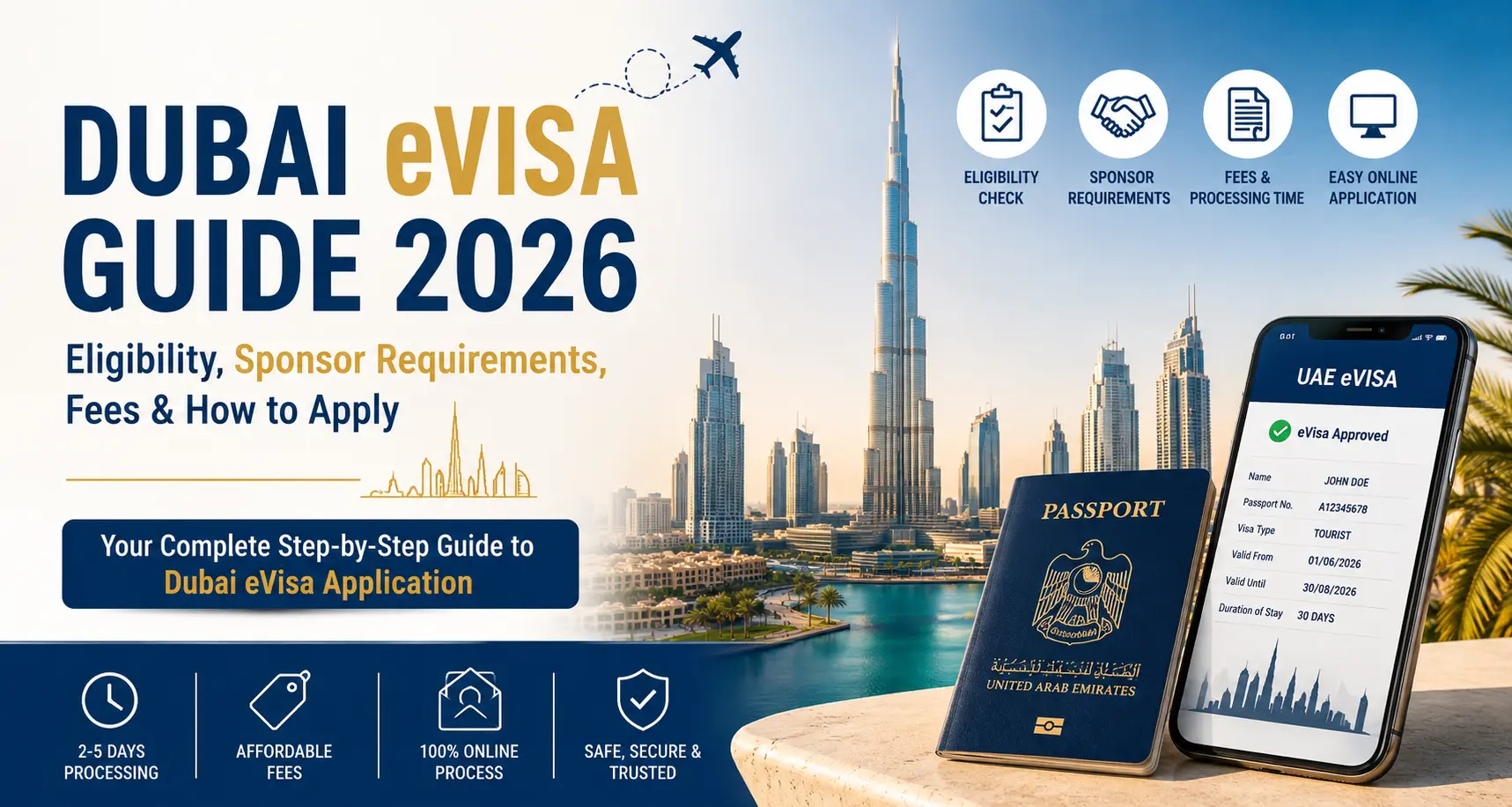
As of July 2026, a Dubai eVisa is a pre-approved electronic entry permit issued by GDRFA Dubai through a UAE-based sponsor. You only need a Dubai eVisa if your nationality is not eligible for visa-free entry or a visa on arrival. A standard 30-day Dubai eVisa typically costs between AED 350 and AED 700 (approximately USD 95–190), with processing usually taking 2–5 working days. If you hold a passport from the US, UK, EU countries, Australia, Canada, or one of around 60 other eligible nations, you most likely do not need a Dubai eVisa. Check the eligibility section below to find out whether you need a visa before travelling.
Many travellers assume they need a visa before flying to Dubai, but that is not always the case. While many nationalities must apply for a Dubai eVisa in advance, others qualify for visa-free entry or a visa on arrival. Confusing these categories is one of the most common reasons travellers either pay for a visa they do not need or arrive at the airport without the required travel documents. This guide explains who needs a Dubai eVisa, who does not, the typical fees in AED and USD, the UAE sponsor requirement, and the step-by-step application process to help you avoid unnecessary delays. If you are looking for a complete country-by-country breakdown of visa-free entry, visa on arrival, and pre-arranged visa requirements, see our guide to Dubai visa eligible countries. This guide focuses specifically on the Dubai eVisa.
Quick Summary - Dubai eVisa
| Issuing Authority | GDRFA Dubai (General Directorate of Residency and Foreigners Affairs) |
|---|---|
| Who Needs It | Travellers whose nationalities are not eligible for visa-free entry or a visa on arrival (see eligibility section) |
| Sponsor Required | Yes — a UAE-based airline, hotel, or licensed travel agency must sponsor the application (self-application is not allowed) |
| Standard Fee (30-day) | AED 350–700 (approximately USD 95–190) |
| Processing Time | Usually 2–5 working days |
| Delivery | Sent by email as a PDF entry permit to present upon arrival in Dubai |
| Visa-Free Alternative | Citizens of around 60+ eligible countries receive a free 90-day visa on arrival |
A Dubai eVisa is an electronic entry permit that allows eligible travellers to visit Dubai and the UAE for tourism, family visits, or short business trips without visiting an embassy or consulate. Issued by GDRFA Dubai, the eVisa is sent by email as a PDF and must be approved before you travel. Unlike a visa on arrival, you need to obtain your Dubai eVisa in advance. Once you arrive at Dubai International Airport (DXB) or Al Maktoum International Airport (DWC), you simply present the PDF copy or a digital version on your device to immigration officials.
Many travellers mistakenly believe an eVisa is just a scanned version of a paper visa. In reality, a Dubai eVisa is a completely digital travel authorisation linked directly to your passport in GDRFA's system. There is no visa sticker or physical document to collect. If you're unsure whether you need a Dubai eVisa or a traditional visa, our paper visa vs. eVisa comparison explains the differences in detail.
One important point that many guides overlook is that not every traveller needs a Dubai eVisa. Citizens of around 60+ eligible countries can receive a free 90-day visa on arrival, meaning they do not need to apply for an eVisa before travelling. The next section will help you determine whether you need a Dubai eVisa based on your nationality.
Your nationality determines whether you need a Dubai eVisa, whether you qualify for visa-free entry or a visa on arrival, and how far in advance you should plan your trip.
If you hold a passport from one of the following countries, you generally receive a free 90-day visa on arrival and do not need to apply for a Dubai eVisa:
In total, around 60+ nationalities are eligible for visa on arrival. Indian passport holders fall under a separate category. You may qualify for a visa on arrival only if you hold a valid US visa, UK visa, or an EU residence permit. Otherwise, you must apply for a Dubai eVisa before travelling. For the complete country-by-country list, refer to our Dubai visa eligible countries guide.
If your nationality is not eligible for visa-free entry or a visa on arrival, you must obtain a Dubai eVisa before your trip. This requirement applies to many travellers, including most passport holders from:
This is not a complete list. If your nationality is not included in either category, you should confirm your visa requirements before booking your trip, as you may still need to apply for a Dubai eVisa.
For most applicants, getting a Dubai eVisa is a straightforward process, provided all required documents are accurate and complete. However, approval is not automatic. Every application is reviewed by GDRFA Dubai through standard security and document verification checks. Errors such as incorrect passport details, previous UAE immigration violations or overstays, and missing or incomplete documents can result in processing delays or even visa rejection, regardless of your nationality. We explain the most common reasons in our Dubai visa rejection reasons guide and cover them again later in this article.
The terms Dubai eVisa, visit visa, and visa on arrival are often used interchangeably, but they refer to different entry options. Understanding the difference helps you choose the correct visa before travelling. If you want to compare all available visa types, durations, and entry options, see our guide to the different types of Fly UAE Visa.
| Category | Applied Before or After Arrival | Sponsor Required | Typical Processing Time | Best For |
|---|---|---|---|---|
| Dubai eVisa (Pre-Arranged) | Before travel | Yes - UAE-based airline, hotel, or licensed travel agent | 2–5 working days | Travellers who are not eligible for visa on arrival |
| Visit Visa via Licensed Agent | Before travel | Yes - the licensed agent provides sponsorship | 2–5 working days | Longer stays (60 or 90 days), multiple-entry visas, or family-sponsored visits |
| Visa on Arrival | At the airport | No | Immediate | Eligible nationalities, including the US, UK, most EU countries, Australia, Canada, and similar |
Processing times and visa fees may change without notice. Before booking your trip, always confirm your visa category and eligibility with a licensed visa agent or the official GDRFA or ICP portal.
If your nationality is eligible for a visa on arrival, there is usually no need to apply for a visa before travelling. It is the simplest and most cost-effective option, as you can complete the entry process upon arrival in Dubai.
If you are not eligible for visa-free entry or a visa on arrival, you must apply for a Dubai eVisa before your trip. A pre-approved Dubai eVisa is the required entry permit for tourism and short family visits.
Travellers planning a longer stay, multiple entries, or a family-sponsored visit should compare the available Dubai visit visa categories before applying, as a standard 30-day Dubai eVisa may not be the most suitable option.
One of the most important parts of the Dubai eVisa process is the UAE sponsor requirement. Unlike some countries that allow travellers to apply directly through a government portal, you cannot submit a Dubai eVisa application to GDRFA as an individual. Every application must be submitted through a UAE-based sponsor, such as an airline, a hotel, or a licensed travel agent. There is no self-service government portal for tourists to apply on their own.
In most cases, your application follows one of three routes. Your airline may sponsor your visa as part of your flight booking, your hotel may sponsor it after you confirm your accommodation, or a licensed UAE travel agent can sponsor and submit the application on your behalf. The sponsor submits your documents to GDRFA, pays the applicable government fees, and sends you the approved Dubai eVisa once it has been issued. For more details about who can sponsor your application and how each option works, refer to our Dubai visa sponsor guide.
This sponsor requirement is also why licensed travel agents play an important role in the application process. They act as the UAE-based sponsor, verify your documents, submit the application to GDRFA, and help ensure the process is completed correctly and on time.
The Dubai eVisa requirements are generally the same for most travellers who need a pre-arranged visa, although some documents may vary depending on your sponsor and the purpose of your visit. Before applying, make sure you have the following documents ready.
The following issues are common reasons for application delays or rejection:
These terms are often confused, but they have different meanings.
The cost of a Dubai eVisa depends on the visa type, your nationality, the processing option you choose, and your application channel. As a general guide, a 30-day Dubai eVisa typically costs AED 350–700 (approximately USD 95–190), while a 60-day Dubai eVisa usually ranges from AED 580–950 (approximately USD 158–260). These estimates generally include the government fee, 5% UAE VAT, and standard service charges, which is why prices may vary between different providers.
| Dubai eVisa Type | Price (AED) | Price (USD) | Typical Processing Time |
|---|---|---|---|
| 30-Day Single Entry eVisa | AED 350–700 | USD 95–190 | 2–5 working days |
| 60-Day Single Entry eVisa | AED 580–950 | USD 158–260 | 2–5 working days |
| Urgent / Express Processing (Add-on) | +AED 300–750 | +USD 82–204 | 24–48 hours (subject to availability) |
| 96-Hour Transit Visa (for comparison) | AED 50 | Approximately USD 14 | 1–2 working days |
The prices above are approximate and are based on publicly available GDRFA and ICP-referenced information available in mid-2026. Dubai eVisa fees may change at any time and can vary depending on your nationality, sponsor, and selected processing speed. Always confirm the latest applicable fee with your licensed visa provider before submitting your application.
Before starting your Dubai eVisa application, make sure you have the following:
It is recommended to apply for your Dubai eVisa at least 7 days before your planned departure. Although standard processing usually takes 2–5 working days, applying early provides extra time for weekends, public holidays, or any requests for additional documents. If your travel date is less than 3 days away, ask your sponsor whether an express processing option is available instead of relying on the standard processing timeline.
Most Dubai eVisa applications are processed within 2–5 working days, although the exact timeline can vary depending on several factors.
Common factors that may affect processing time include:
| Stage | What Happens | Typical Timing |
|---|---|---|
| Submission | Your sponsor submits the Dubai eVisa application to GDRFA. | Day 1 |
| Review | GDRFA carries out document verification and security checks. | Day 1–3 |
| Approval | The approved Dubai eVisa PDF is issued and sent to your sponsor. | Day 3–5 |
| Travel | You must enter the UAE before your visa's entry window expires. | Before the visa expiry date |
The timelines above are based on standard processing patterns in 2026 and may change during busy travel seasons. Always confirm the expected processing time with your sponsor before booking non-refundable flights or accommodation.
For travellers who need a pre-approved visa, a Dubai eVisa offers several practical advantages:
Once your Dubai eVisa is approved, your sponsor will send you a PDF entry permit that includes your name, passport number, visa validity, and permitted stay duration. Keep both a printed copy and a digital copy on your phone, as airlines may request it during check-in and UAE immigration officers will verify it upon arrival.
After arriving in Dubai, you will proceed to the immigration counter, where an officer will verify your passport and approved eVisa before stamping your entry. Smart Gates are generally available for UAE and GCC nationals, UAE residents, and eligible travellers with biometric passports who qualify under the Smart Gate programme. Most Dubai eVisa holders should expect to complete the standard immigration process unless they meet the applicable Smart Gate eligibility requirements. If you are unsure, check your eligibility through the official GDRFA Smart Gate service before travelling.
Yes. A Dubai eVisa is valid for entry into the UAE and is not limited to Dubai alone. After entering the country, you can travel freely to Abu Dhabi, Sharjah, Ajman, Ras Al Khaimah, Fujairah, and Umm Al Quwain during the validity of your permitted stay.
Imagine a traveller with a 30-day Dubai eVisa remains in the UAE for 4 days after the visa expires without applying for an extension. Under the current UAE overstay policy, GDRFA and ICP apply a flat overstay fine of AED 50 per day across all visa types and emirates. In this example, the traveller would be required to pay approximately AED 200 (around USD 54) before leaving the country. The overstay fine starts from the first day after the visa expires, with no grace period.
The best way to avoid this situation is to apply for a visa extension before your current visa expires, rather than waiting until after the expiry date. Our UAE visa overstay rules guide and Dubai visa rejection guide explain the available options if you overstay or need to reapply after a visa refusal.
Although most travellers focus on the Dubai eVisa application fee, additional costs are more likely to arise from missed deadlines or incorrect paperwork. Applying on time and ensuring your documents are accurate can help you avoid unnecessary delays, penalties, and travel disruptions.
Most Dubai eVisa applications are delayed or rejected because of simple mistakes during the document review process rather than eligibility issues. Some of the most common reasons include:
If your Dubai eVisa application has been rejected, it does not necessarily mean you cannot apply again. In many cases, correcting the issue and submitting a new application is enough. Our Dubai visa rejection reasons guide explains the most common causes and what you should fix before reapplying.
Disclaimer: The fees, processing times, and other information provided on this page are based on publicly available GDRFA and ICP-referenced information as of 2026. Visa fees, processing times, and UAE immigration policies may change without prior notice. This information should not be considered a guarantee of visa approval, entry into the UAE, or fixed pricing. Always confirm the latest requirements with GDRFA, ICP, or a licensed UAE visa provider before making non-refundable travel bookings.
| Myth | Reality |
|---|---|
| Approval is guaranteed once you submit your documents. | Every Dubai eVisa application is reviewed by GDRFA through document verification and security checks. Approval is common but never guaranteed. |
| An approved Dubai eVisa guarantees entry into the UAE. | A valid eVisa allows you to travel, but the final decision to admit a traveller is made by the immigration officer at the port of entry. |
| Every visitor to Dubai must apply and pay for a Dubai eVisa. | Travellers from around 60+ eligible countries receive a free visa on arrival and do not need to apply for a Dubai eVisa. |
| You can apply for a Dubai eVisa directly through a government portal. | Dubai eVisa applications must be submitted by a UAE-based sponsor, such as an airline, hotel, or licensed travel agent. |
| The cheapest Dubai eVisa service is always the best option. | Very low prices may exclude important services, such as document verification, customer support, or other essential assistance during the application process. |
Once your Dubai eVisa is approved, a little planning can make your trip more comfortable. If you are travelling between May and September, expect high temperatures and schedule outdoor activities during the early morning or evening while visiting indoor attractions during the hottest part of the day.
The official currency is the UAE Dirham (AED). Credit and debit cards are widely accepted, but carrying a small amount of cash is useful for taxis, small shops, and tips.
Buying a local SIM card or eSIM at the airport is recommended, as it provides immediate access to maps, ride-hailing apps, and other essential travel services. While Dubai has a relaxed dress code in most tourist areas, modest clothing is recommended when visiting mosques or government buildings. Carrying a light layer can also be helpful.
If you are visiting during Ramadan, keep in mind that restaurant operating hours and attraction timings may be adjusted during the daytime.
For getting around the city, the Dubai Metro is an affordable and convenient option for many major attractions, while Careem and Uber are useful for destinations not connected by the metro. Planning your itinerary in advance can help you avoid unnecessary travel time, as Dubai's attractions are spread across different parts of the city.
This guide has been prepared and reviewed by the FLYUAEVISA editorial and licensed visa advisory team, which regularly assists travellers with Dubai eVisa and visit visa applications. The information is based on practical application experience and is cross-checked with publicly available references from GDRFA and ICP to help ensure accuracy.
Visa fee ranges, sponsor requirements, and processing timelines are reviewed periodically to reflect changes in UAE immigration policies. Where a specific fee, rule, or requirement cannot be independently verified, it is clearly identified rather than presented as confirmed information.
Throughout this guide, we refer readers to the official GDRFA and ICP resources whenever appropriate so that important visa information can be verified directly from the relevant UAE authorities. Our goal is to provide clear, accurate, and transparent information without making claims that cannot be independently confirmed.
What is a Dubai eVisa?
A Dubai eVisa is a pre-approved electronic entry permit issued by GDRFA Dubai. It is delivered by email and allows eligible travellers to visit the UAE for tourism, family visits, or short business trips without visiting an embassy or consulate.
Do I need a Dubai eVisa, or can I get a visa on arrival?
Your visa requirement depends on your nationality. Citizens of around 60+ eligible countries, including the US, UK, most EU countries, Australia, and Canada, can receive a free visa on arrival. Travellers from other countries must obtain a Dubai eVisa before travelling.
Can I apply for a Dubai eVisa without a sponsor?
No. A Dubai eVisa application must be submitted through a UAE-based sponsor, such as an airline, hotel, or licensed travel agent. Individual travellers cannot apply directly to GDRFA.
How much does a Dubai eVisa cost?
A 30-day Dubai eVisa typically costs AED 350–700 (approximately USD 95–190), while a 60-day Dubai eVisa generally costs AED 580–950 (approximately USD 158–260). The final amount depends on your nationality, sponsor, and processing option.
How long does it take to process a Dubai eVisa?
Standard processing usually takes 2–5 working days after all required documents have been submitted. Express processing may be available for certain nationalities and visa categories.
How far in advance should I apply for a Dubai eVisa?
It is recommended to apply at least 7 days before your planned travel date. This provides enough time to accommodate weekends, public holidays, or requests for additional documents.
What happens if my Dubai eVisa application is rejected?
A rejection is not always permanent. In many cases, applications are refused because of document errors, incorrect information, or previous UAE immigration issues. Once the issue is resolved, you can usually submit a new application.
Is a Dubai eVisa the same as a Dubai visit visa?
A Dubai eVisa is one type of Dubai visit visa. The term visit visa includes several visa categories, such as longer-duration visas, multiple-entry visas, and family-sponsored visas, while an eVisa specifically refers to the electronic pre-approved entry permit.
Can I use a Dubai eVisa to visit other Emirates?
Yes. A Dubai eVisa is valid throughout the UAE. After entering the country, you can travel to all seven Emirates, including Abu Dhabi, Sharjah, Ajman, Ras Al Khaimah, Fujairah, and Umm Al Quwain, during your permitted stay.
What documents are required for a Dubai eVisa application?
Applicants generally need a passport valid for at least 6 months, a recent passport-size photograph, a confirmed return or onward flight ticket, hotel or host details, and valid travel insurance. Some nationalities may also be required to provide recent bank statements.
Does the validity of a Dubai eVisa start from the issue date or the entry date?
The visa validity period begins from the date of issue and determines how long you have to enter the UAE. Your permitted stay duration starts only after you enter the country.
Applying for a Dubai eVisa is a straightforward process once you know whether you need one. The first step is to check your eligibility, as travellers from many countries can enter the UAE with a visa on arrival and do not need to apply in advance. If you do require a Dubai eVisa, ensuring that your documents are accurate, meeting the UAE sponsor requirement, and applying within the recommended timeframe will help your application proceed smoothly. After submitting your application, you can monitor its progress through our Dubai visa status check guide.
Our licensed team can help you confirm your eligibility, review your documents, and sponsor your Dubai eVisa application from start to finish.
📧 Email: visa@flyuaevisa.com
💬 WhatsApp: +971 55 547 7921
Dubai International Airport is the primary airport of Dubai and serves as the ma...
Read More
Managing government and private services across the Emirates has become much eas...
Read More
Palm Jumeirah has always drawn visitors who want a waterfront experience unlike...
Read More
Every household in the UAE that employs a maid, nanny, driver, cook, or caregive...
Read More
Indian Independence Day is celebrated every year on 15th August, honoring the na...
Read More